
Search
Search
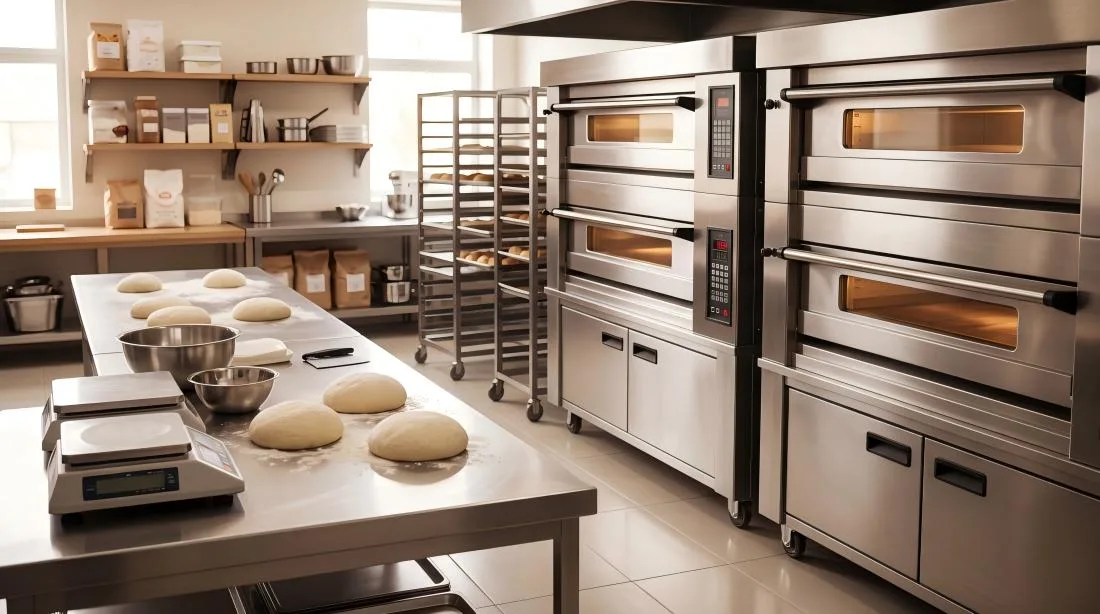
Starting a bakery takes more than a great sourdough starter or a reliable buttercream recipe. The equipment you choose shapes product consistency, scaling speed, and how much profit you keep.
Whether you are launching a micro-bakery at home or planning a high-volume production space, the equipment market can feel overwhelming. This guide walks through what you need at each stage of production.
Prices and codes in this guide reflect the US market. Home bakers should also check local cottage food rules, as many regions limit what they can sell, especially fillings like cream or custard.
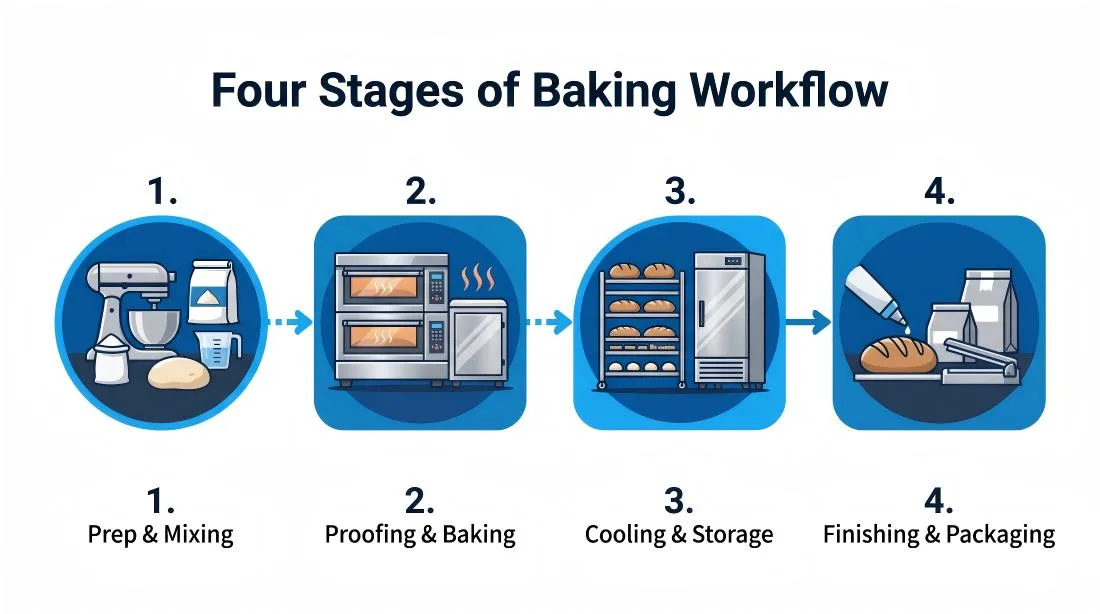
What you need depends on your menu and daily volume. Most bakeries need equipment in four functional areas: preparation and mixing; fermentation and baking where applicable; cooling and temperature-controlled storage; and finishing and packaging.
The exact workflow depends on what you make. Laminated dough, for example, goes into the cooler before it reaches the oven, while a cookie line may never need a proofer.
Start with stainless steel mixing bowls, sturdy spatulas, bench scrapers, and a mixer that can handle your dough without overheating. If laminated pastry is on your menu, a reversible dough sheeter can keep thickness consistent, though you can roll small batches by hand.
A digital scale is just as important. Weighing every ingredient standardizes your recipes, reduces raw-material waste, and keeps portions consistent. That consistency protects your margins as volume grows.
The oven does most of the heavy lifting. Convection ovens work well for many cookies and pastries. For delicate batters and lightweight products, look for adjustable fan speeds or a gentle airflow setting.
For artisan bread, a deck oven with a stone hearth supplies strong bottom heat. Also compare steam capacity, loading capacity, and batch recovery time, because the crust depends on more than the hearth.
Proofing and baking need different controls. Proofing requires suitable temperature and humidity, while baking depends on consistent heat delivery and, for some products, controlled airflow or steam. Check that a proofing cabinet offers the controls your products need.
Many new bakers run short on cold storage. Reach-in coolers fill quickly with bulk butter, resting laminated dough, and cakes chilling overnight. Plan capacity around your menu, batch sizes, and delivery frequency.
If you expect strong growth, check whether the space can take extra reach-ins or a walk-in cooler later. That is a growth option, not a requirement for every bakery.
Baked goods also need room to cool, or the bottoms turn soggy. Multi-tier wire racks on casters save floor space and make it easy to move large batches. Racks only release heat before packaging, though.
Products with temperature-sensitive fillings, such as cream or custard, need a separate, validated cooling and cold-storage procedure. Your local food safety rules set the details.
Finishing and packaging shape how customers judge your brand. Choose ambient or refrigerated display cases based on your products and their food-safety requirements. Cream and custard items require refrigerated display, while many dry baked goods do not.
At higher volumes, hand decorating can become a production bottleneck. Before buying any machine, find the bottleneck first. Count how many pieces per hour each step must handle, then evaluate automating the step that holds up the whole line.
A bakery runs on small items as much as big machines. Use these four groups to check your list.
Include packaging materials and labels in the budget as ongoing supplies, separate from packaging machinery.
Evaluate automation when a manual step limits output. Compare the investment with expected labor savings, increased saleable capacity, reduced cleaning time, and ongoing operating costs. The machines below are from HSENDA, our own line, and each one targets a specific bottleneck.
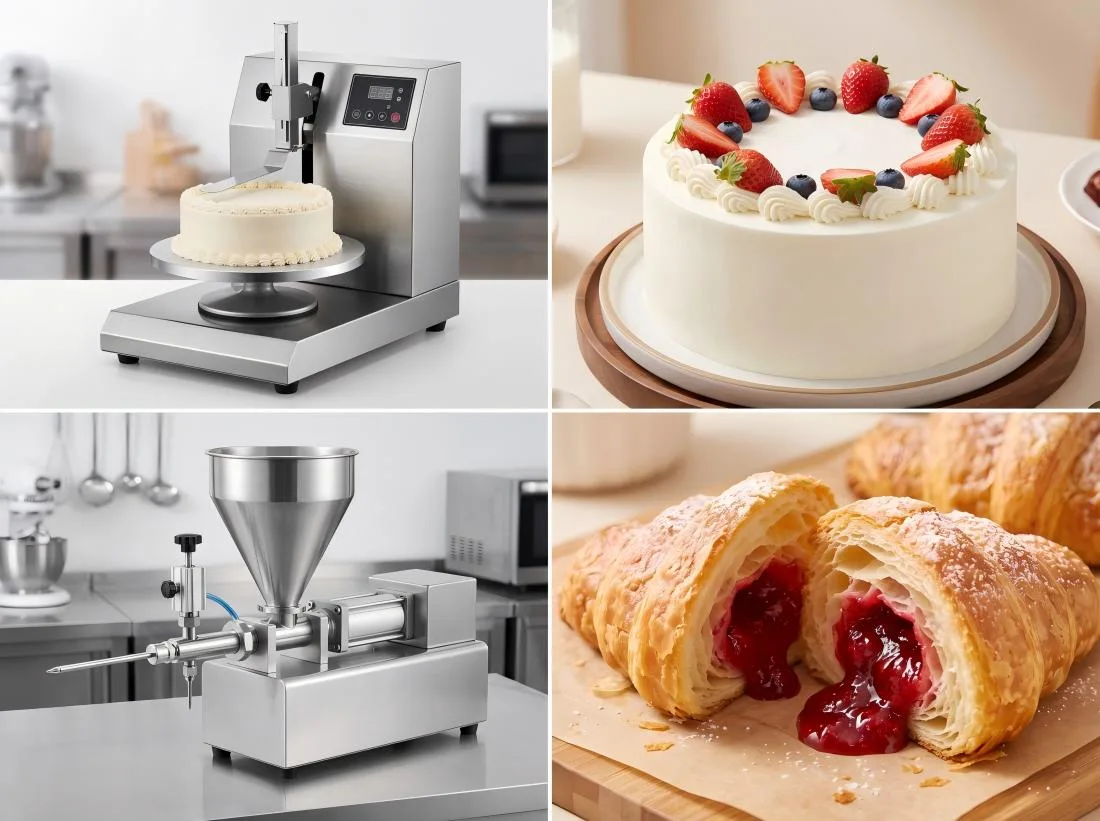
Decorating: The HSENDA SD102 Cake Decoration Machine can decorate a 7-layer cake in about 20 seconds. It pairs a servo motor with cylinder action to control both light and hard cream, and one operator can reach 1,500 to 1,800 cakes in a 10-hour shift.
Whipping: The HSENDA S50 Cream Whipping Machine whips mousse, ice cream, coffee, and milk tea toppings quickly. Its food-contact core components are FDA-certified. You can adjust the whipping specific gravity, which describes how dense the cream is after whipping.
Filling and Slicing: The HSENDA SI260 Side Injecting Machine fills cakes, bread, croissants, and eclairs with cream, jam, or custard, with a weight accuracy of ±0.5 g. The HC401 Horizontal Cutting Machine cleanly slices cake bases and bread and offers adjustable cutting speed.
Packaging: The HSENDA UP450 Film Flow Wrap Packing Machine uses dual-frequency conversion and a photoelectric eye to accurately track and seal products. Each sealing temperature is controlled independently, so it suits a range of films.
Cartons: The SK20 Automatic Carton Erector and BS50 Automatic Box Sealing Machine can operate independently or integrate into an automated packing line as volume grows.
Equipment choices change with batch size, product mix, and production targets. The table below shows common options, not fixed requirements.
| Equipment Category | Small-Batch Bakery | High-Volume Bakery |
| Oven | Convection oven | Multi-deck oven or rack oven |
| Mixer | Planetary mixer sized to your batch (e.g., 20 qt) | Planetary or spiral mixer matched to dough type and batch weight |
| Refrigeration | Reach-in cooler | Additional reach-ins or walk-in storage; blast chilling where the process requires it |
| Finishing | Manual piping bags and hand tools | Product-specific automation where finishing is a bottleneck (e.g., HSENDA SR660 for cake production) |
| Packaging | Hand-applied labels and boxes | Packaging systems matched to the product, pack format, and required output |
Mixer choice depends on your product, not just its size. Planetary mixers are versatile and handle cake batter, cookie dough, whipped mixes, and frosting. Spiral mixers are designed for bread, bagel, and pizza dough. Bowl volume alone doesn’t determine usable batch capacity; it also depends on the recipe, batch weight, and dough absorption.
The menu table below shows common configurations, not minimum purchase requirements for every operator. For example, you can roll laminated dough by hand or with a sheeter.
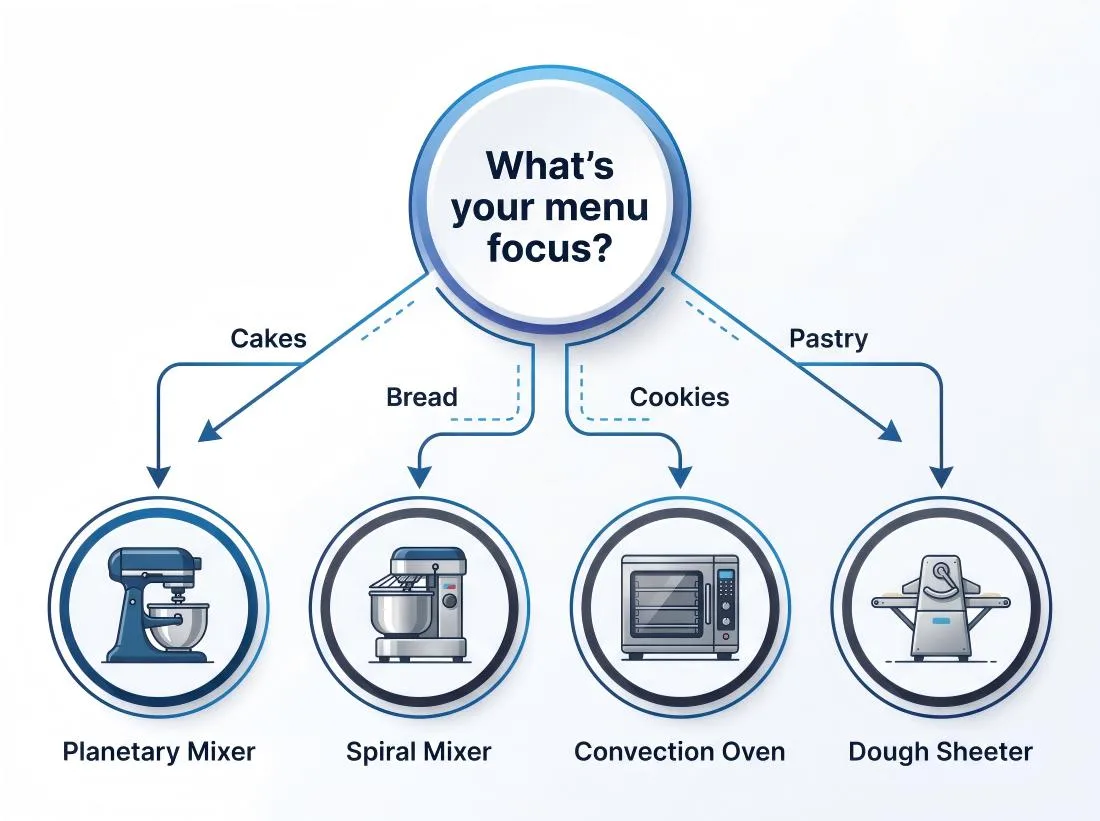
| Menu Focus | Typical Equipment to Consider | Product- or Volume-Dependent Additions |
| Cakes and Desserts | Planetary mixer, oven, refrigerated storage | Depositor, injector, slicer |
| Artisan Bread | Spiral or planetary mixer, deck or other suitable oven | Steam capability, proofing cabinet, dough divider, retarder |
| Cookies | Mixer, convection oven, cooling racks | Cookie depositor, flow wrap |
| Laminated Pastry | Suitable oven, refrigeration, work surface and rolling tools | Dough sheeter; proofing cabinet for yeasted products; blast chiller |
A good budget keeps you from running out of cash halfway through the build. The individual equipment examples below are for new equipment, priced in US dollars, and exclude tax, freight, installation, and site upgrades. Third-party setup estimates may use different assumptions, so check their scope before comparing figures.
Full-size commercial convection ovens vary widely. Some sell for under $3,000, while double-deck units can reach roughly $13,600 or more. Example prices start around $1,000 for an entry-level 20-qt commercial planetary model, with larger machines costing substantially more.
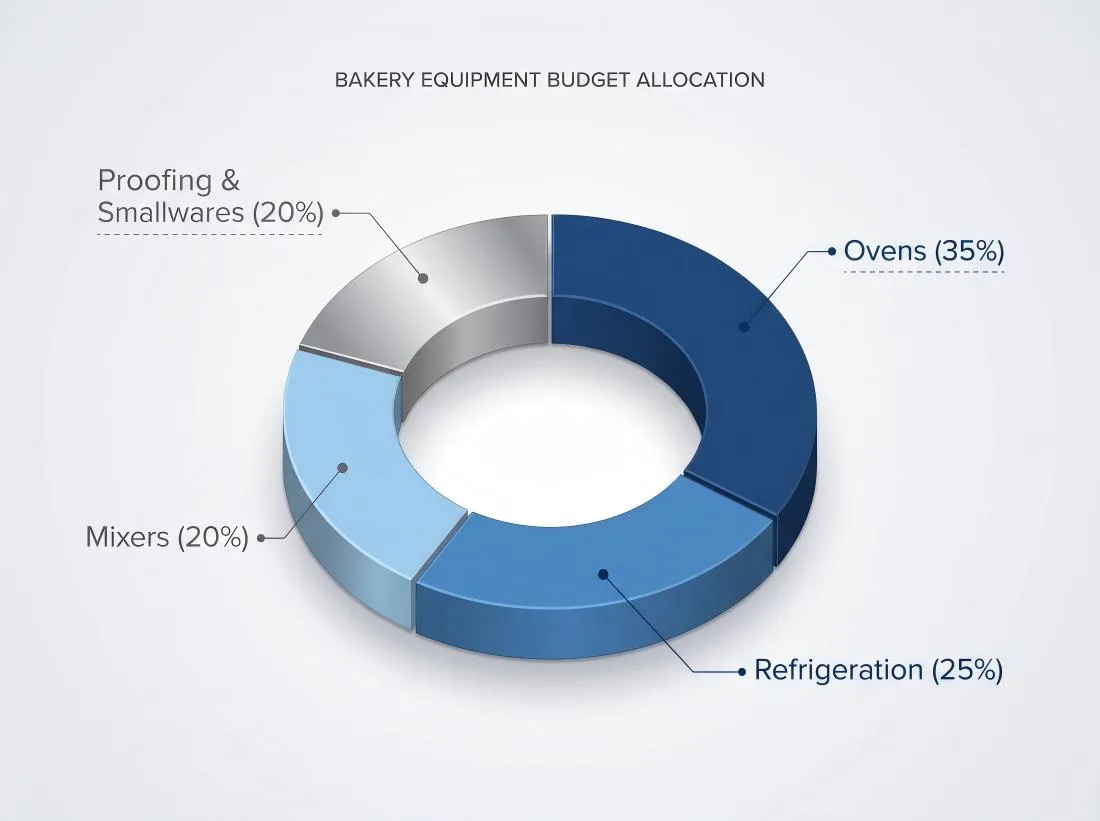
Proofing cabinets range from about $1,400 for basic models to $4,000 or more with advanced controls. Stainless tables, scales, and racks depend entirely on how many you need, so list your exact quantities before you budget.
Epos Now provides a broad estimate of $60,000 to $200,000 for commercial bakery equipment, with costs varying by scale, new versus used purchases, and required equipment. Treat this as a third-party planning reference, not a quotation for an all-new setup. Home and small bakeries depend heavily on what you already own, so collect written quotes.
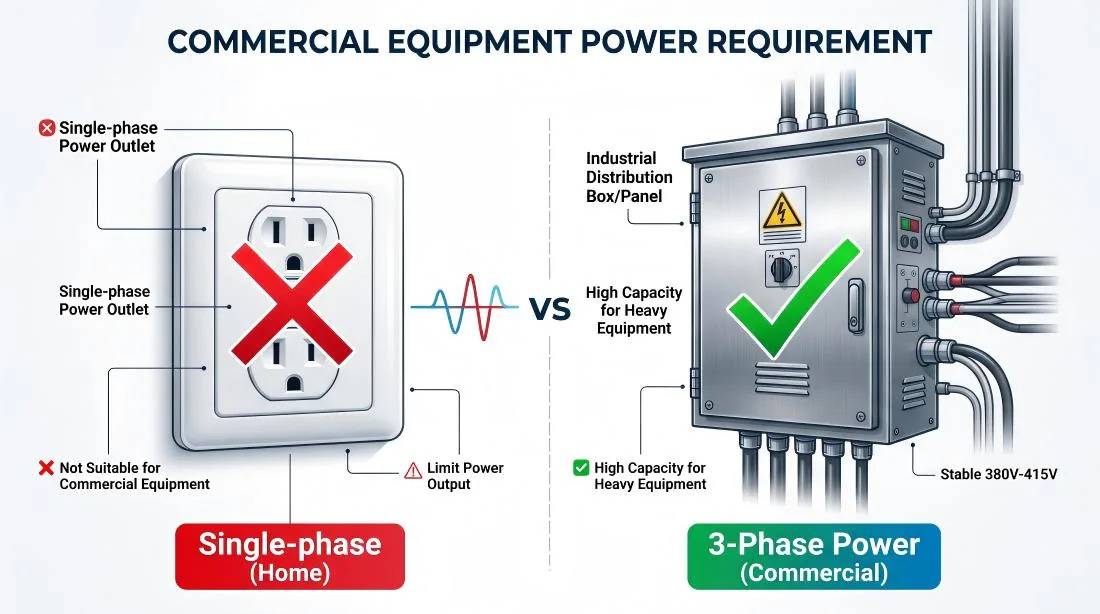
Many beginners buy a high-capacity mixer or a large oven, only to find the space cannot power it. Voltage, phase, and amperage vary by model. In the US, you may see 208V or 240V, single-phase or three-phase. Confirm these on the specification sheet before you buy.
Upgrading the electrical panel after signing a lease can cost thousands of dollars and delay your opening date.
Ventilation needs the same early attention. NFPA 96 covers fire safety for commercial cooking ventilation, and it is not the only deciding factor. A Type I hood handles grease and smoke, while a Type II hood handles heat and steam. Not needing a Type I hood doesn’t mean you don’t need ventilation, so confirm with your local authorities and a licensed contractor.
Used equipment makes sense for durable items such as stainless prep tables, sinks, and wire racks. Complex machinery is different, because the savings can disappear quickly when something breaks.
Don’t assume the original manufacturer’s warranty transfers with used equipment. Some manufacturers limit coverage to the original end user. Confirm the remaining coverage, transfer conditions, and any dealer-backed warranty in writing.
Without a maintenance record, you’re more likely to miss scheduled service and less able to plan repairs before peak production periods. Log service dates, repairs, and usage, then use those records alongside the manufacturer’s maintenance schedule to plan inspections and servicing.
Asset tracking serves a separate financial purpose. Recording purchase costs, service expenses, and replacement plans helps you manage equipment spending. Confirm depreciation and tax treatment with your accountant.
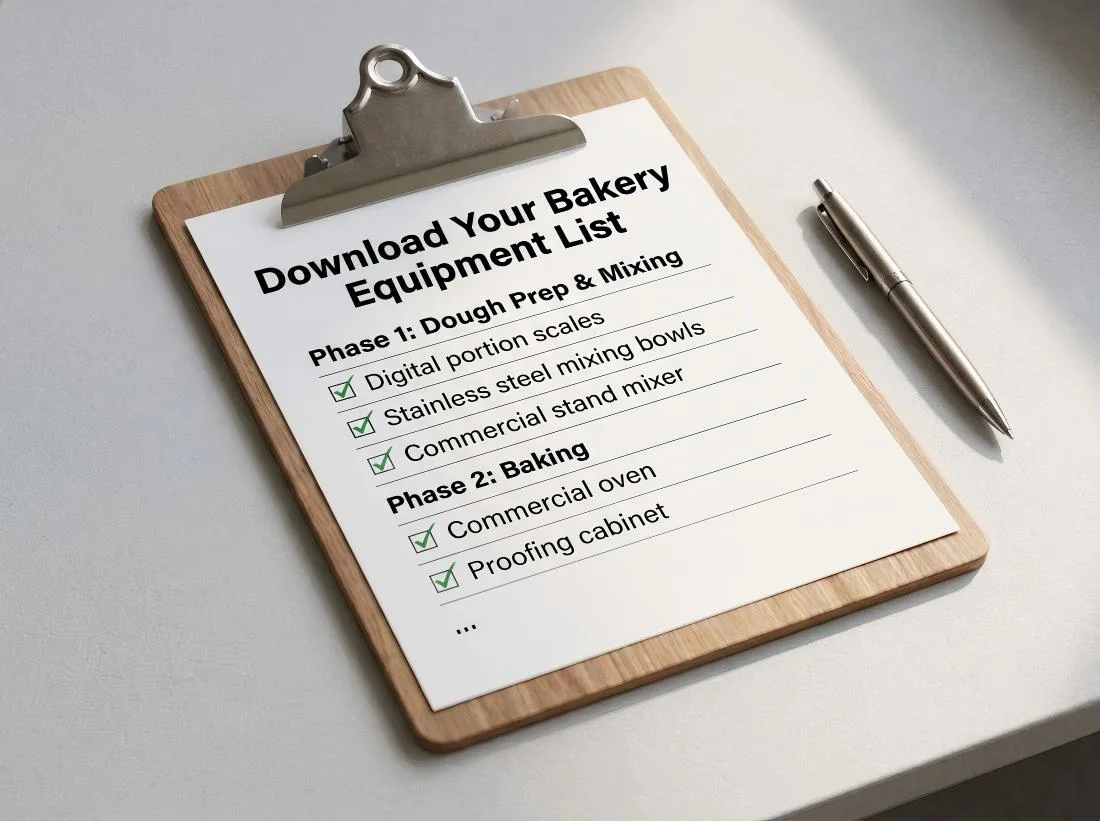
Tracking every spatula, scale, and storage bin during a build-out is easy to get wrong. Our printable checklist helps you stay organized with each purchase.
Use the button below to download the free PDF. It includes fields for each item’s purpose, priority, quantity, utility requirements, supplier quotes, installation costs, and warranty details, so you can compare offers on total cost, not just sticker price.
It depends on your menu and where you sell. Most bakeries need an oven, a mixer, refrigeration, prep tables, a digital scale, baking tools, a handwashing sink, and thermometers. Check local permit rules, especially if you start from home.
Costs vary with scale and what you already own. Epos Now estimates costs of $60,000 to $200,000 for a broad range of commercial bakery equipment, depending on whether you buy new or used. Small and home setups cost much less, so build a priced list of exactly what you need.
The core tools are a digital scale, flexible spatulas, heavy-duty whisks, bench scrapers, stainless steel mixing bowls, measuring cups, and reusable silicone baking mats.
A good kitchen balances your menu goals with a realistic budget. Identify your bottleneck before buying machines, confirm electrical and ventilation requirements, and decide carefully where it is safe to use used equipment. Then keep maintenance records so the kitchen serves you for years to come.